

TLDR
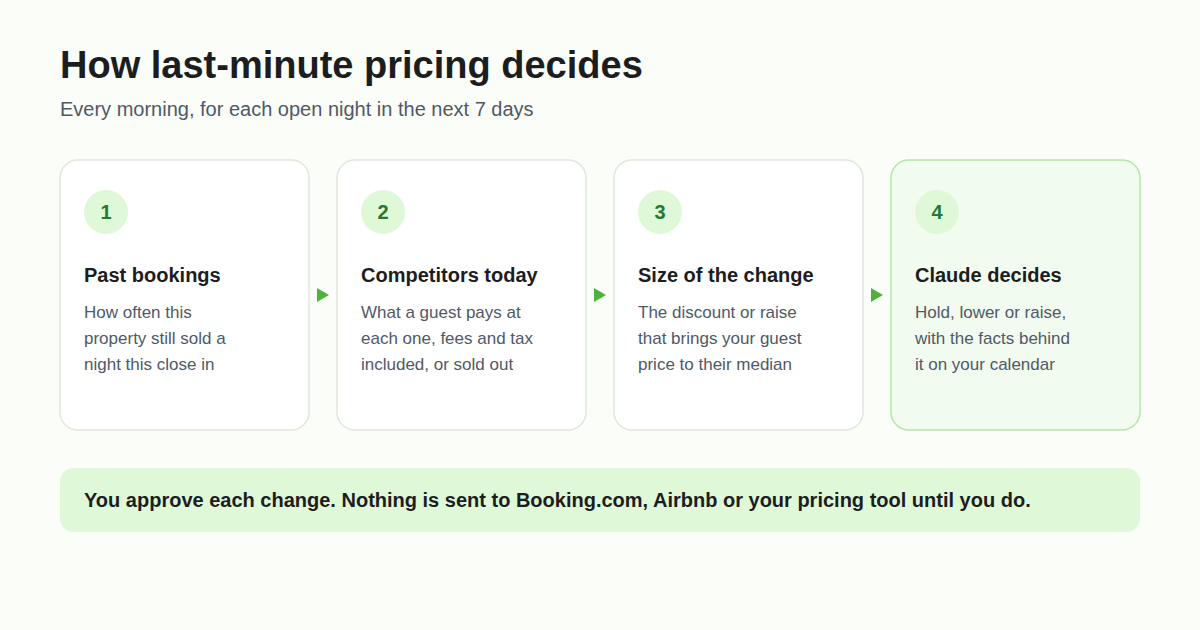
- Every morning we go through each property’s open nights in the next 7 days and decide, night by night, whether to lower the price, raise it or leave it alone.
- The order comes from your own past bookings, which is how often that property still sold a night this close in. The nights least likely to sell are looked at first.
- The size of a change comes from your competitors. We read what a guest pays at each one that morning, fees and tax included, and size the discount or raise to bring your guest price to their median.
- On one UK portfolio on 18 November 2026 it looked at about 800 open nights, left about 700 of them alone, and two thirds of the changes it suggested were raises.
- It’s in early access, and nothing changes on your listings until you approve it.
A revenue manager looking at an empty night a few days out wants to know whether it would have sold anyway, and where its price sits against the places a guest would book instead. Last-minute pricing in myDataValue checks the same two things for every open night, every morning, so you only review the nights where something should change.
You keep your pricing tool for base prices and market data. We sit on top of it and your Booking.com and Airbnb accounts, and pull it together for the last-minute calls.
Step 1: how often the night still sells, from past bookings
We start from your own reservations and calendars. For each property we count its past nights that were still open a given number of days before, and how many of those then sold. A property might read “sells 28% at 7 days (47 nights)”.
This decides the order, so the nights least likely to sell are looked at first. It also changes what a cut is worth. If a property rarely sells this close in then a lower price has more to gain, and if it usually sells anyway then a hold or a raise makes more sense.
When there isn’t enough history we say so, for example “7 days: 12 nights, too few”, and we don’t guess.
Step 2: what guests pay at each competitor that morning
For the nights where a change is on the table, we read the property’s Booking.com comp set that morning for the same dates and the same length of stay. Each competitor gets one line, which is what a guest pays there a night with fees and tax included, or that it’s sold out, or that it isn’t listed for those dates.
Sold out counts as demand. Not listed doesn’t, because the place may just have a longer minimum stay or a closed arrival day. If only a few competitors have a price we say how many, for example “4 of 10 priced”, so you know how much to trust the median.
We also look at where you rank in search against that comp set, how many of your page views turn into bookings against theirs, and your rating against theirs. An Airbnb night is compared with Airbnb’s own range for similar listings.
Step 3: a discount sized to the comp set’s median
There is no flat percentage. The change is sized so that what a guest pays for your property lands on the comp set’s median, or on the best alternative when one is cheaper and rated higher.
The change is made where you choose. With a pricing tool connected it can go in as a price there, which keeps every channel level. Or it goes out as the same last-minute deal on Booking.com and Airbnb, which adds a badge that can lift the listing in search.
Every suggestion names your minimum price for that night and says how far above or below it the new price lands.
Step 4: Claude makes the call, you approve
Claude goes through all of that for each open night and picks one answer, which is hold, lower, raise, a deal or a shorter minimum stay. The picks are on your calendar each morning, and each night has a card that shows how the price was reached and why.
You tick the ones you agree with and send them. Nothing is sent to Booking.com, Airbnb or your pricing tool until you do. You can also ask for the same run in Claude or ChatGPT through our connector.
An example: a night it raised
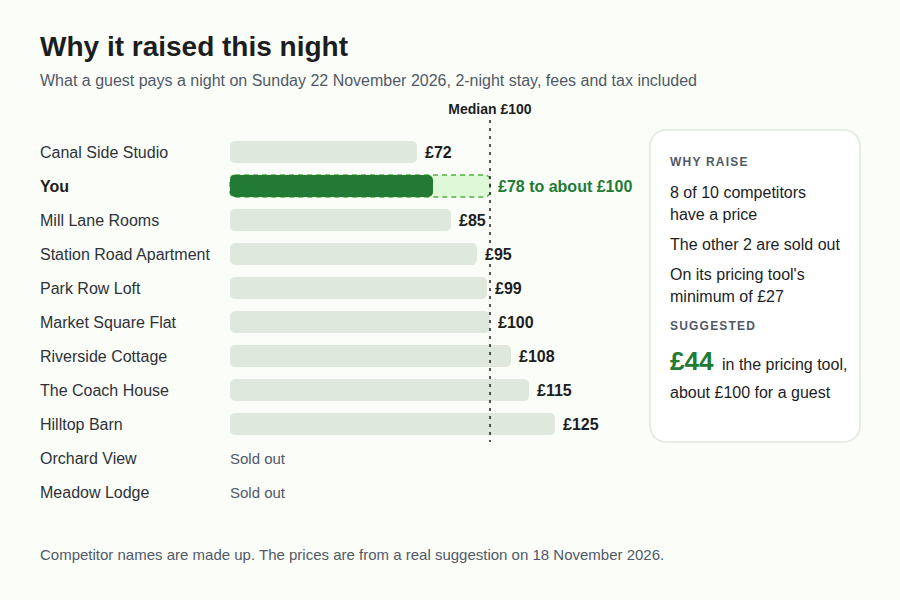
This one is from the run on 18 November 2026, for a studio with a Sunday night open 4 days out. A guest would pay £78 a night there for a 2-night stay, fees and tax included. Eight of its ten competitors had a price, from £72 to £125 with a median of £100, and the other two were sold out. The studio was sat on its pricing tool’s minimum of £27.
So the suggestion was £44 in the pricing tool, which is about £100 for a guest.
An example: a night it cut
The same morning a one-bed flat had the opposite picture. A guest would pay £91 a night against a median of £79. It was last of the six listed places in its comp set’s search results, it was rated lower, and 0.5% of its page views turned into a booking against 3.8% for the comp set. There was also a cheaper competitor with a higher rating.
The suggestion was a cut that brings the guest price to about £79.
What one morning looked like
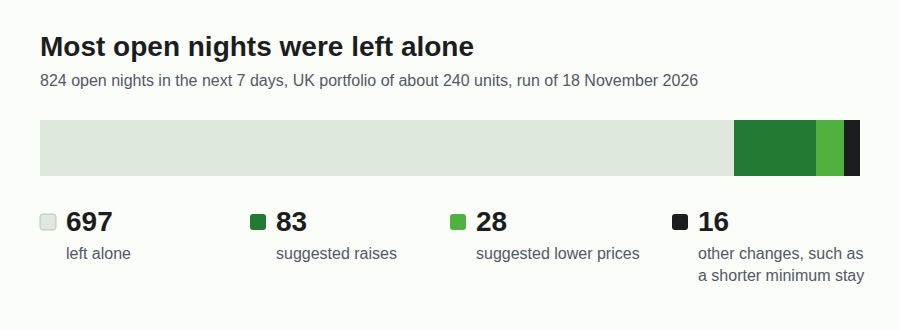
On a UK portfolio of about 240 units, the run on 18 November 2026 looked at about 800 open nights over the next 7 days. It left about 700 of them alone and suggested a change on the rest, across 64 properties. Two thirds of those changes were raises.
What it doesn’t do yet
- It’s in early access, so it runs each morning for a small group of customers.
- We know how often a night sells this close in at today’s price. We don’t know yet how much a lower price improves that, and each suggestion says so.
- Airbnb’s range for similar listings is closer to a neighbourhood peer group than a picked comp set, so an Airbnb comparison is a rougher guide.
- We can’t yet show how much revenue it adds. We record what happens to each night after a suggestion, and we’ll publish the results when there are enough of them.
If you manage short-term rentals and want to see it on your own listings, book a demo.


